 how-to
Styling Outdoor Jackets for Urban Environments
Table of Contents
- Why Outdoor Jackets Belong in Your City Rotation
- How to Style a Field Jacket for City Streets
- Rain Jacket Outfit Ideas That Stay Dry and Sharp
- Technical Jacket Outfit Ideas for Commutes and Weekends
- Layering Outfits With Outdoor Jackets Without the Bulk
- Choosing the Right Jacket by Weather and Temperature
- Fixing Common Styling Mistakes and Caring for Your Jacket
- Conclusion: Build a Capsule That Moves With You
- Frequently Asked Questions
Last Updated: October 15, 2026
Why Outdoor Jackets Belong in Your City Rotation
Most jackets force a choice: gear that handles weather or pieces that look right on a city block. You end up owning two of everything, and neither one works as hard as it should. Styling outdoor jackets for urban environments closes that gap, and styling outdoor jackets starts with picking pieces built for both.
At Tremendous World, we design for people who move between trails and downtown without changing their whole closet. The right jacket does three jobs at once:
- It blocks rain and wind on the walk to the train.
- It layers over a hoodie or tee without looking bulky.
- It reads clean enough for dinner after work.
A field jacket, a shell, or a lightweight windbreaker can all do this. The trick is the fit and the color, not the label.
outdoor apparel care and weather guidance
How to Style a Field Jacket for City Streets
The field jacket is the easiest outdoor piece to wear in a city. It has structure, big pockets, and a shape that flatters almost any frame. The mistake most people make is treating it like a costume, pairing it with head-to-toe workwear and ending up looking like they wandered off a job site.
Here is how to build a field jacket look for four common urban occasions.
1. The Commute
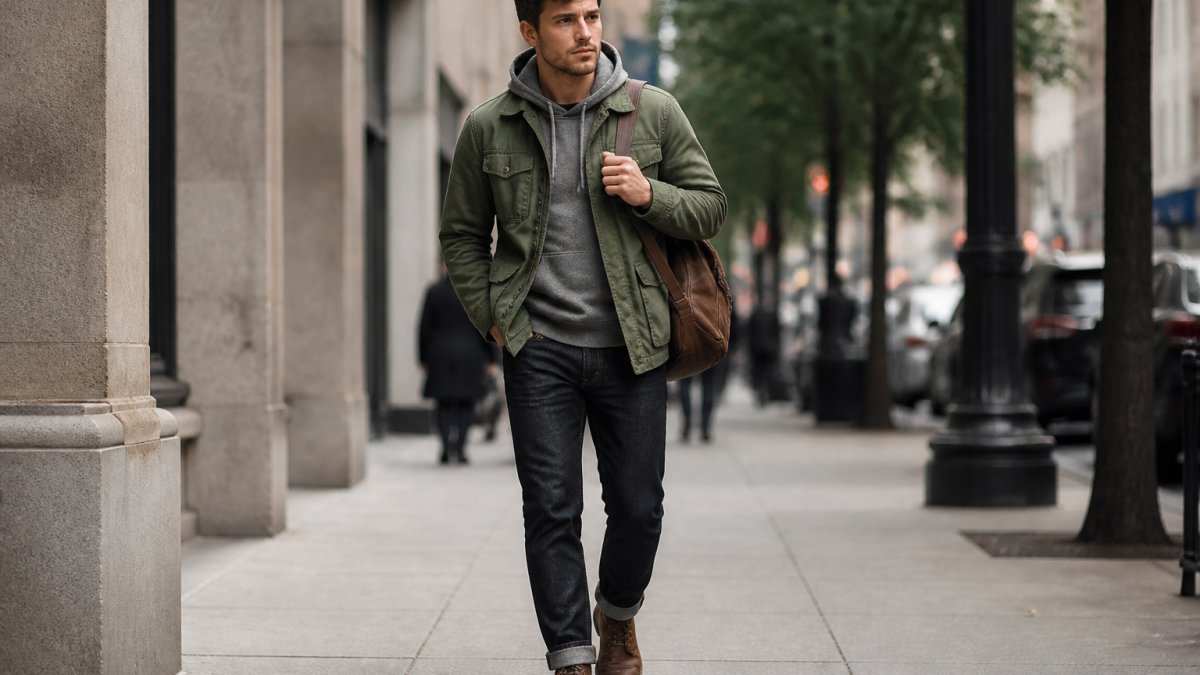
A field jacket is ideal for the walk to the train or the bike ride to the office because it blocks wind and holds up to light rain without the crinkle of a shell.
- Jacket: olive or navy cotton field jacket, hem at the hip
- Top: gray crewneck sweatshirt or a plain white tee
- Bottom: dark indigo jeans, straight or slim-straight
- Shoes: brown leather boots or clean white sneakers
- Bag: a canvas tote or a leather messenger, something that reads intentional, not gym
Keep the palette to two or three colors. Olive, gray, and indigo is a formula that works every time. Swap the sweatshirt for a plain tee in warmer months.
2. The Weekend Errand Run
This is where you can loosen the proportions. A slightly oversized field jacket over a hoodie and joggers reads relaxed without looking sloppy.
- Jacket: same field jacket, worn open
- Top: heather gray hoodie, no graphics
- Bottom: tapered joggers in black or charcoal
- Shoes: retro runners or low-profile sneakers
The key is that the joggers taper at the ankle. Baggy joggers plus a boxy jacket equals bulk. Tapered joggers plus a boxy jacket equals balance.
3. The Casual Dinner or Drinks
A field jacket can go out at night if you dress up the layers underneath.
- Jacket: black or dark olive field jacket
- Top: fine-gauge merino crewneck or a button-down oxford
- Bottom: black jeans or dark chinos
- Shoes: leather chelsea boots or minimal leather sneakers
Skip the hoodie here. The point is to let the jacket read as a casual blazer substitute, not as gear.
4. The Transitional-Weather Day
When the forecast is 55°F and cloudy with a chance of drizzle, the field jacket is the right call, but only if you layer under it.
- Base: moisture-wicking tee or light long-sleeve
- Mid: thin fleece or a quilted vest
- Outer: field jacket
- Bottom: chinos or denim
- Shoes: boots with a lug sole for wet pavement
If the jacket feels tight over the mid layer, size up. A field jacket that fits perfectly over a tee will not fit over a fleece.
Pants and Shoes That Work With a Field Jacket
Match the jacket's weight to your bottoms. Heavy canvas pairs best with denim or chinos. A lighter field jacket can handle joggers or tapered cargos. Avoid wide-leg pants with a boxy jacket, the silhouette gets muddy.
For shoes, stick to boots or clean sneakers. A chunky trail runner can work if the rest of the outfit is minimal.
Rain Jacket Outfit Ideas That Stay Dry and Sharp
Rain jacket outfit ideas usually fail because people wear a shell over dress clothes and look like they're headed to a campsite. The fix is layering the shell over casual wear.
Try these combinations:
- A navy rain shell over a white tee and gray chinos
- A black hooded jacket over dark jeans and white sneakers
- A beige raincoat over a cream sweater and olive pants
Look for a drawstring hood and taped seams. Those two details keep rain out without adding weight.
Technical Jacket Outfit Ideas for Commutes and Weekends
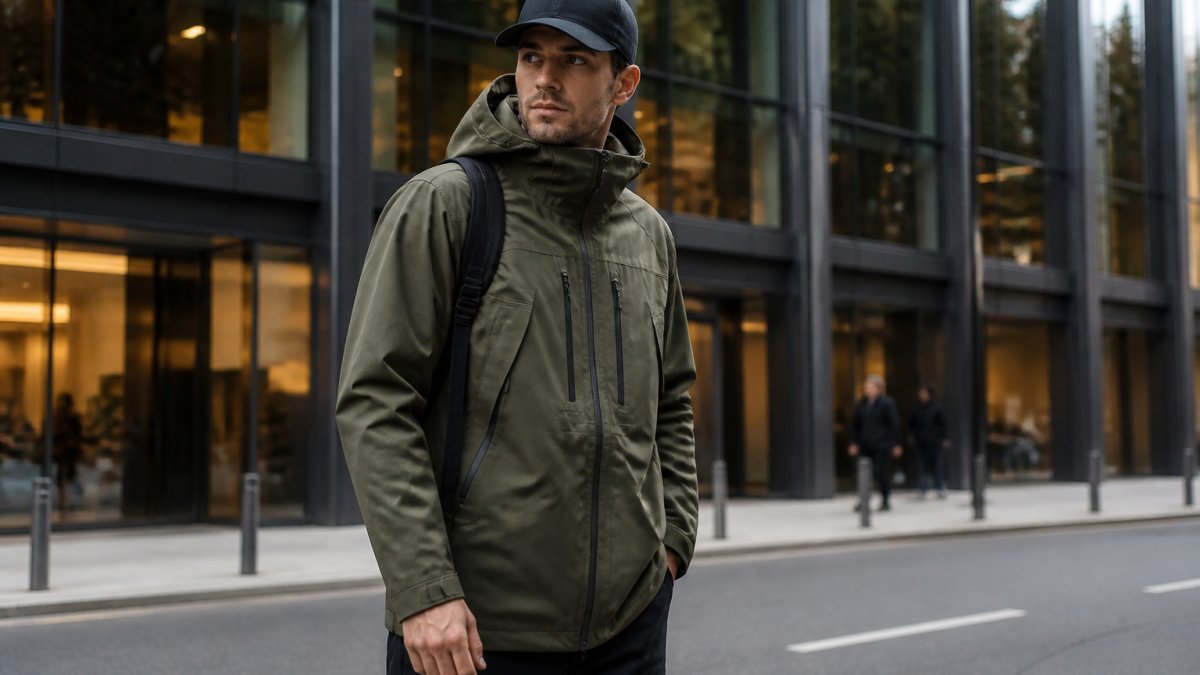
Technical jacket outfit ideas work best when the jacket is the only technical piece in the look. If everything is performance fabric, the outfit reads athletic. If one piece is technical, it reads intentional.
For a commute, pair a technical shell with jeans and a plain sweater. For a weekend, wear it over joggers and a hoodie.
- Commute: shell + sweater + dark denim + boots
- Weekend: shell + hoodie + joggers + sneakers
- Night out: shell + tee + black jeans + leather sneakers
The colors matter here. Beige, gray, and olive blend into a city palette better than bright trail colors.
Layering Outfits With Outdoor Jackets Without the Bulk
Layering outfits with outdoor jackets comes down to three thin layers instead of one thick one. That gives you more warmth and more control when the weather shifts. The reason it works is that trapped air between layers insulates better than a single dense fabric, and you can shed or add a layer as conditions change without carrying a second jacket.
A Simple Three-Layer Formula
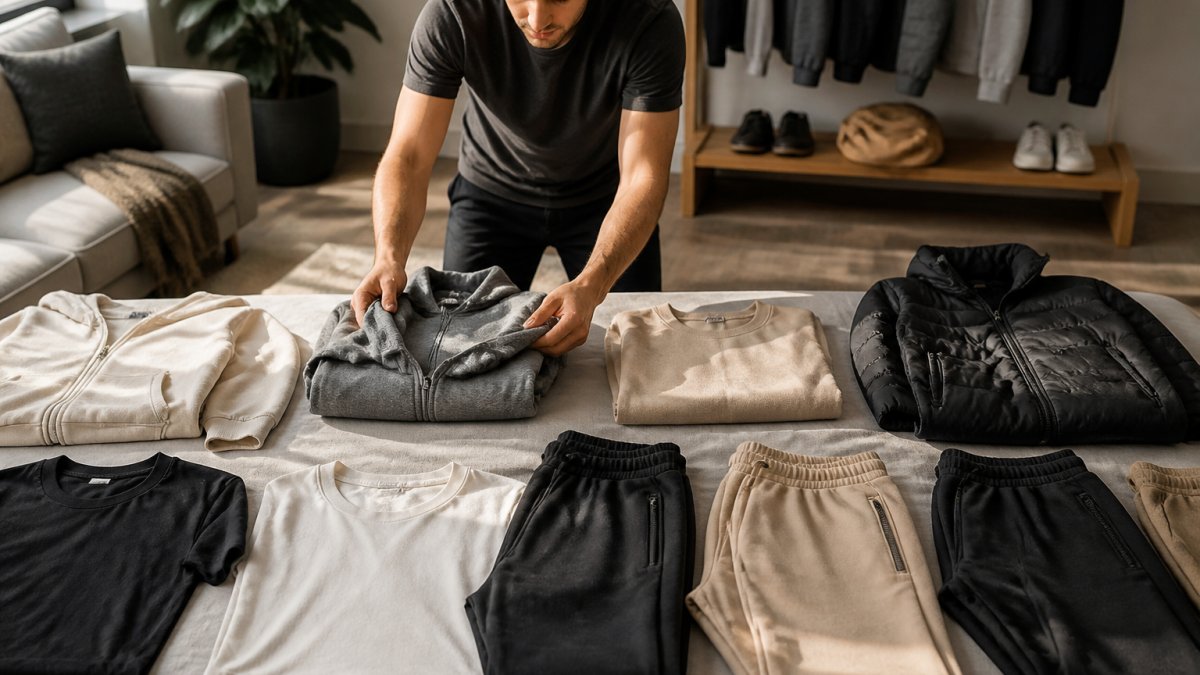
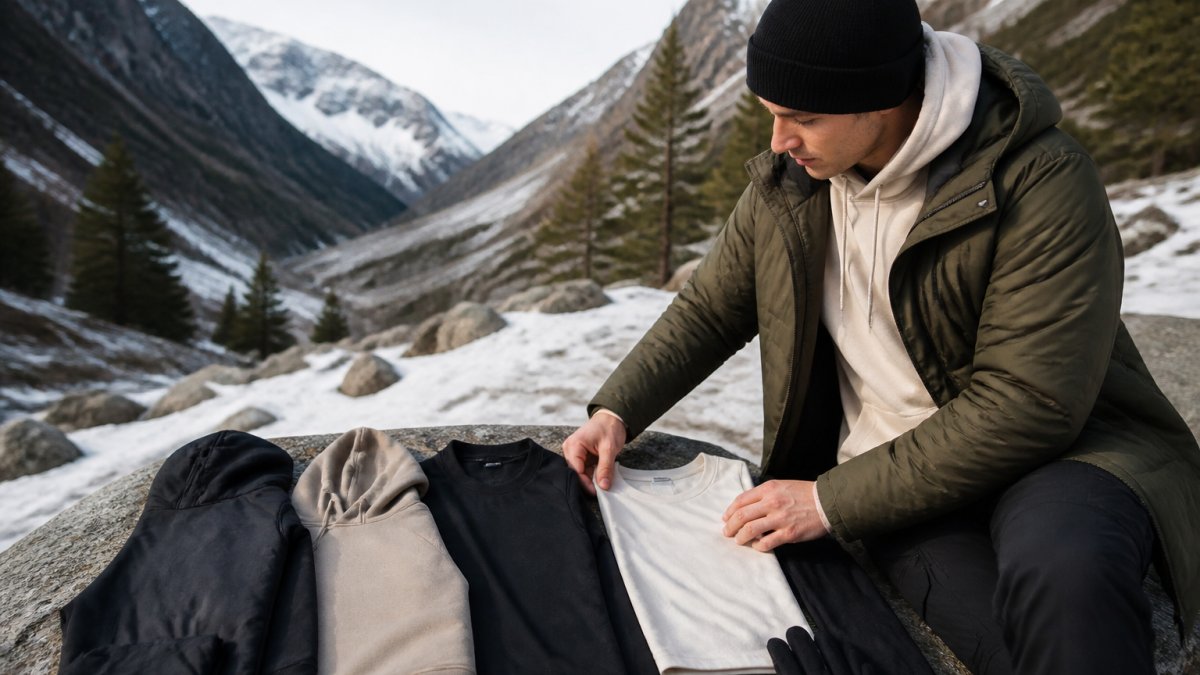
Base layer: a moisture-wicking tee or long-sleeve. This keeps sweat off your skin so you stay dry when you move.
Mid layer: a fleece, light hoodie, or quilted vest. This traps heat and is the layer you remove first when you warm up.
Outer layer: your jacket. This blocks wind and rain and is the layer that determines whether the outfit reads urban or trail.
Here is how the layers map to conditions:
| Condition | Base | Mid | Outer |
|---|---|---|---|
| Mild, dry (60°F+) | Tee | None | Windbreaker |
| Cool, dry (50-60°F) | Tee | Fleece | Field jacket |
| Cold, dry (40-50°F) | Long-sleeve | Fleece | Puffer or insulated field jacket |
| Rainy, cool (40-60°F) | Tee | Hoodie | Rain shell |
| Cold and wet (below 40°F) | Long-sleeve | Fleece | Insulated shell or parka |
How to Test the Fit Between Layers
Each layer should fit under the next without pulling. Here is a quick check you can do in a fitting room or at home:
- Put on your base and mid layers.
- Zip the outer layer halfway.
- Raise your arms overhead. If the jacket rides up past your waist or the shoulders bind, the outer layer is too small.
- Cross your arms in front of you. If you feel tightness across the back, size up.
- Sit down. If the hem digs into your hips, the jacket is too long for layering.
A jacket that fits perfectly over a tee will not fit over a fleece. If you plan to layer, size up one from your tee-only fit.
Adapting When the Temperature Swings
Most urban days are not one temperature. A 45°F morning can turn into a 60°F afternoon. The three-layer system handles this because you can remove the mid layer and carry it or stash it in a bag.
- Morning: base + mid + outer
- Midday: base + outer (mid layer in your bag)
- Evening: base + mid + outer again
This is why a packable mid layer, a thin fleece or a lightweight quilted vest, beats a heavy sweater. It compresses small enough to fit in a tote or backpack without adding bulk to your silhouette.
Avoiding the Bulk Trap
Bulk comes from three places: too many layers, too-thick layers, or a jacket that is too small to accommodate the layers underneath. The fix is to keep each layer thin and to size the outer layer for the thickest combination you plan to wear.
- Too many layers: three is the practical maximum for city wear. A fourth layer adds warmth but kills mobility.
- Too-thick layers: a heavy fleece under a field jacket will make you look like a stuffed jacket. A thin fleece or a vest does the same job with less volume.
- Too-small outer layer: if the jacket pulls across the chest or back when you layer, it is the wrong size, not the wrong jacket.
Choosing the Right Jacket by Weather and Temperature
Pick your jacket by the weather you'll actually face, not the season on the calendar. Transitional weather is where most people get it wrong.
- Above 60°F and dry: a lightweight windbreaker is enough.
- 50-60°F: a field jacket or canvas jacket handles it.
- 40-50°F: add a mid layer under a field jacket or shell.
- Below 40°F: switch to a puffer or a parka with a hood.
- Any rain: a rain shell beats everything else.
Fixing Common Styling Mistakes and Caring for Your Jacket
Most styling problems come from fit, not the jacket itself. Here's what to check.
- Too long: the hem should hit at the hip, not mid-thigh, on a city jacket.
- Too baggy: you should be able to layer one piece under it, not three.
- Wrong color: bright trail colors stand out. Beige, gray, green, and black work better.
- No pockets: you want at least two hand pockets and one chest pocket.
For care, follow the tag. Most shells need a gentle wash and air dry. Reapply a waterproof coating when water stops beading on the surface.
Conclusion: Build a Capsule That Moves With You
The real challenge isn't finding one great jacket. It's building a small set that covers every condition without crowding your closet.
Start with a field jacket for everyday wear, add a rain shell for wet days, and a lightweight windbreaker for mild ones. That's three pieces that handle almost everything.
Tremendous World builds premium athletic lifestyle apparel and streetwear for people who move between city streets and mountain trails.
Frequently Asked Questions
How do you style an outdoor jacket for everyday wear?
Start with a neutral base like jeans and a plain tee, then add the jacket as the statement piece. Roll the sleeves once to show your wrists, keep colors to three or fewer, and finish with clean sneakers or boots. A chore or field jacket in beige, green, or gray works for errands, coffee runs, and casual office days. The goal is styling outdoor jackets so they read as intentional, not like you just came off a trail.
How can you make a rain jacket look stylish?
Choose a matte finish over shiny plastic and a cut that hits at the hip or mid-thigh. Pair it with tailored joggers or dark denim, waterproof boots, and a structured bag. Stick to one bold color and keep everything else neutral. A drawstring hood and clean seams help it look considered. For rain jacket outfit ideas, layer a lightweight fleece underneath so the jacket becomes the outer shell, not the whole look.
How do you layer an outdoor jacket without looking bulky?
Use thin, close-fitting base layers and mid-layers. A merino or synthetic tee, a light fleece, then the jacket adds warmth without volume. Avoid cotton hoodies under puffy shells. Look for jackets with articulated sleeves and a hem that sits at your hip bone. If you can pinch more than an inch of fabric at your chest, size down. Layering outfits with outdoor jackets works best when each piece is thin and the outer shell does the weather protection.
Which outdoor jacket styles work best for urban outfits?
Chore jackets, field jackets, and lightweight parkas are the most versatile. They have clean lines, useful pockets, and neutral colors that pair with jeans, chinos, or joggers. A hooded jacket with a drawstring hood handles rain and wind without looking technical. Canvas jackets break in over time and look better with wear. For transitional weather, a windbreaker or raincoat in gray, beige, or green covers most city days.
EPA guidance on textile care and sustainability